
How to Scrape eCommerce Price Monitoring Software Data to Help Retailers
Published on September 27, 2025
Price competition in the e-commerce space is relentless. From small D2C brands to large multinational retailers, everyone competes on pricing—often in real time. As a result, e-commerce price monitoring software has become essential for tracking competitors' prices, understanding market trends, and optimizing product listings.
But what if you could go one step further? What if, instead of just using traditional pricing tools, you could scrape data from eCommerce price monitoring software and gain even broader market visibility—insights across multiple retailers, products, and regions?
This blog explores how scraping eCommerce price monitoring tools or platforms can help retailers gain a competitive edge, what data can be extracted, how to do it responsibly, and how these insights can be turned into revenue-driving decisions.
1. What Is eCommerce Price Monitoring Software?
Price monitoring software allows retailers to track and analyze competitors’ pricing for similar or identical products across different online platforms. Popular tools include:
- Prisync
- Price2Spy
- Wiser
- Omnia Retail
- DataCrops
- Minderest
- Intelligence Node
- Competera
These tools offer dashboards, APIs, and alerts that help businesses:
- React quickly to competitor price changes
- Monitor MAP (Minimum Advertised Price) violations
- Plan promotions effectively
- Protect profit margins
2. Why Scrape Data from Price Monitoring Tools?
While these tools offer structured data, they often require a subscription or have limits on data access (e.g., price feeds for only 50 competitors or 1000 SKUs). Web scraping enables:
Broader Data Collection
Scrape across tools or from tool dashboards to gather insights from multiple markets, SKUs, and retailers.
Competitor Benchmarking
Gain visibility into competitors’ entire price intelligence workflows—what they’re tracking, which SKUs they care about, and how they react to price drops.
Pricing Trends Over Time
Capture historical price data over time by scheduling scrapes, allowing you to build your own price change timeline.
Cross-Platform Comparison
Pull prices from multiple retailers or marketplaces shown in these dashboards, even if the software only exposes limited API endpoints.

3. What Data Can Be Scraped from Price Monitoring Tools?
| Data Point | Description |
|---|---|
| Product Name | Full title of tracked SKU |
| Competitor Store | e.g., Amazon, Walmart, Target, Flipkart |
| Current Price | Real-time price listed on competitor site |
| MRP / List Price | Manufacturer's Suggested Retail Price (MSRP) |
| Discount % | Percentage off MSRP |
| Stock Availability | In stock, low stock, or out-of-stock indicators |
| Last Price Update Time | Timestamp of last price change |
| Buy Box Owner (Amazon) | Seller currently controlling Buy Box |
| Violation Alert (MAP) | Flags for minimum price violation |
4. Use Cases for Retailers
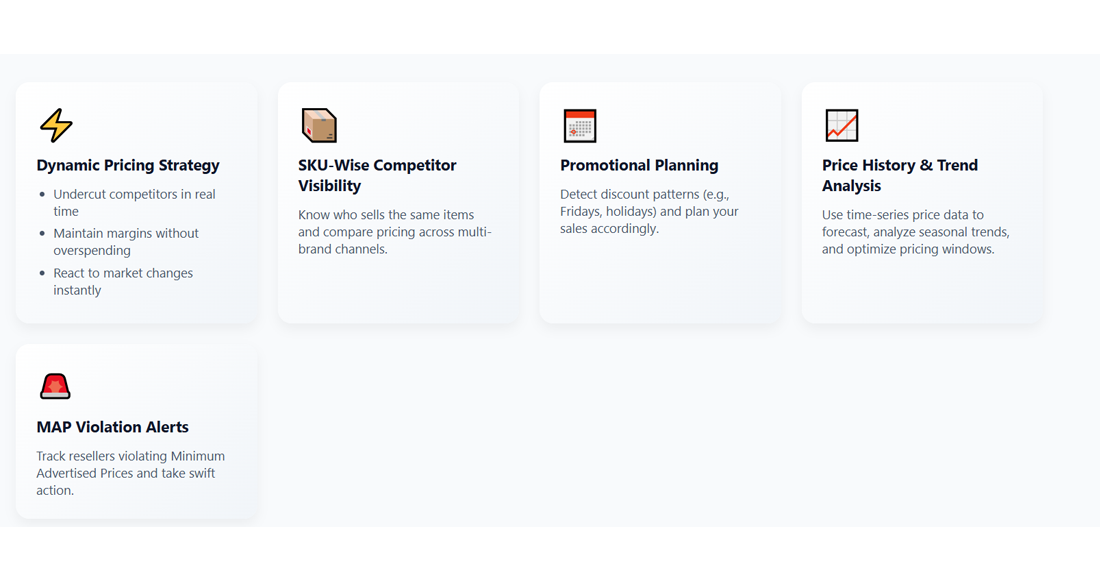
Dynamic Pricing Strategy
Scraped data allows retailers to:
- Undercut competitors in real time
- Avoid unnecessary discounts
- Maintain margin while staying attractive
SKU-Wise Competitor Visibility
Understand who is offering the same products and at what prices—crucial for multi-brand retailers.
Promotional Planning
Find out when competitors typically drop prices (e.g., Friday evenings, payday weeks) and align your campaigns.
Price History & Trend Analysis
Schedule scrapers daily to build your own time-series price database for forecasting and seasonal analysis.
MAP Violation Alerts
Monitor whether resellers are violating minimum advertised price agreements—and take appropriate action.
5. How to Scrape Price Monitoring Software (Responsibly)
Scraping SaaS dashboards or tools should always be done with care and only where permitted by their terms of service. Many tools offer public or limited-access dashboards, trial plans, or data exports that can be scraped ethically.
Scraping Public Dashboards
If the tool has:
- Publicly accessible dashboards
- HTML or JS-rendered price feeds
- Public demos (like Prisync or Wiser)
You can use a browser-based scraping solution like Selenium or Playwright.
Sample Python Workflow (Selenium + BeautifulSoup)
from selenium import webdriver
            from bs4 import BeautifulSoup
            import pandas as pd

            # Setup headless browser
            options = webdriver.ChromeOptions()
            options.add_argument('--headless')
            driver = webdriver.Chrome(options=options)

            # Navigate to demo or public dashboard URL
            driver.get('https://demo.prisync.com/prices')

            # Parse HTML
            soup = BeautifulSoup(driver.page_source, 'html.parser')

            # Example selectors (customize based on the site)
            products = soup.find_all('div', class_='product-row')
            data = []

            for product in products:
                title = product.find('span', class_='product-title').text.strip()
                price = product.find('span', class_='price').text.strip()
                competitor = product.find('span', class_='competitor').text.strip()
                data.append([title, price, competitor])

            driver.quit()

            # Save to CSV
            df = pd.DataFrame(data, columns=['Product', 'Price', 'Competitor'])
            df.to_csv('price_monitor_data.csv', index=False)
6. Integrating Scraped Data with Business Systems
| Integration Target | How It Helps |
|---|---|
| ERP / Inventory Systems | Recalculate margins based on competitor pricing |
| eCommerce CMS (Shopify) | Trigger pricing rule updates |
| BI Dashboards (Power BI) | Visualize price trends and gap analysis |
| Marketing Tools | Run competitor-sensitive promotions |
7. Challenges in Scraping Monitoring Software
| Challenge | Solution |
|---|---|
| Login/Session Requirements | Use Selenium with login automation |
| JavaScript-heavy dashboards | Use Playwright or headless Chromium |
| Rate Limits & Bot Detection | Rotate IPs, add time delays, use CAPTCHA solvers |
| Frequent HTML structure changes | Use robust XPath/CSS selectors |
8. Legal & Ethical Considerations
Important: Scraping proprietary software services must be done responsibly and within legal boundaries.
- Use public data or open trials
- Do not scrape protected user accounts
- Avoid unauthorized access or data resale
- Review and respect robots.txt and TOS
Instead of scraping sensitive interfaces, consider asking for data partnerships or custom exports from the provider.
9. Alternatives to Scraping Monitoring Tools
If scraping SaaS dashboards is too risky or blocked, here are alternatives:
Affiliate Product APIs
Many retailers (e.g., Amazon, Walmart, Flipkart) offer APIs for price tracking.
Price Aggregator Feeds
Use feeds from:
- Google Shopping
- Idealo
- PriceGrabber
- Shopzilla
White-Labeled Intelligence
Partner with pricing intelligence services that offer dashboard exports, alerts, and APIs directly.
10. Conclusion
Scraping price monitoring software data—when done ethically—offers eCommerce retailers a unique layer of intelligence. It bridges the gap between automated insights and broader market visibility, enabling:
- Real-time pricing decisions
- SKU-specific competitor analysis
- Historical price trend development
- MAP enforcement and promotional intelligence
In a market where prices change daily and consumer loyalty is fragile, being data-driven is non-negotiable. Scraped pricing intelligence gives you the power to not just react to market changes, but anticipate and outpace them.
